Chapel
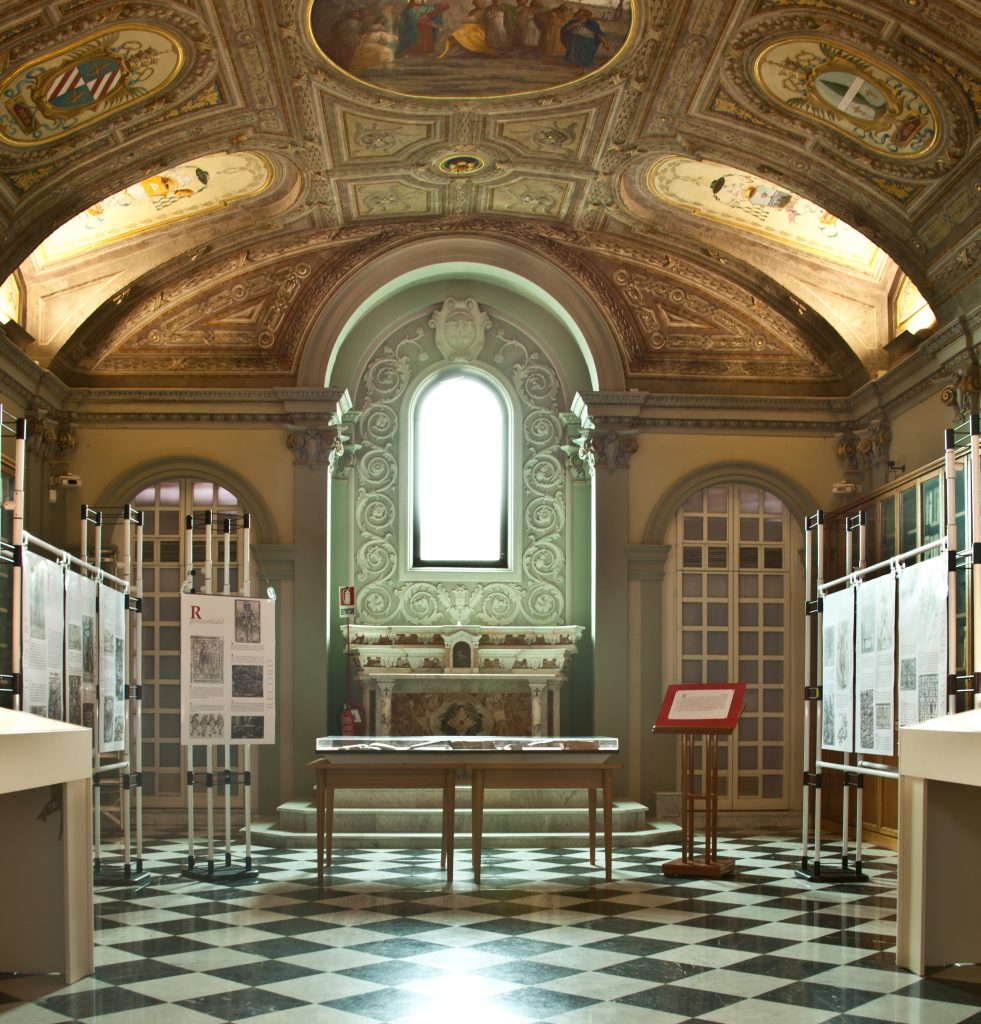
On the ground floor of the former Seminary building, inaugurated in 1778, is the Chapel, which until the mid-1950s was the Seminary’s oratory. It currently houses the oldest and most valuable part of the University Library’s rare and precious heritage: manuscripts, incunabula, a considerable number of 16th-century editions, and a smaller number of 17th- and 18th-century editions. The Chapel also houses the Print Room, established in 1946 to collect engravings by Sardinian artists.
The structure of the Chapel consists of a single nave with a barrel vault and six side lunettes finely decorated with stuccoes and wall paintings. On the back wall, three steps lead up to the marble altar, made by a Sardinian workshop in the early 19th century, with a tabernacle with a silver door depicting the Agnus Dei.
At the top of the arch is the coat of arms of the University of Cagliari, depicting the Virgin Mary in the center, flanked by the crowned coat of arms of Cagliari, still bearing the poles of Aragon, as the University was founded during the Spanish era, and that of the Kingdom of Sardinia with the four Moors. At the base are the emblems of the Sardinian Pope Ilario and the bishops Lucifero and Eusebio.
The entire vault of the chapel is decorated with faux relief in monochrome white and gold inserts. In the center, inside rounded frames, are representations of “The Delivery of the Keys to St. Peter” and “Maria sedes Sapientiae” respectively.
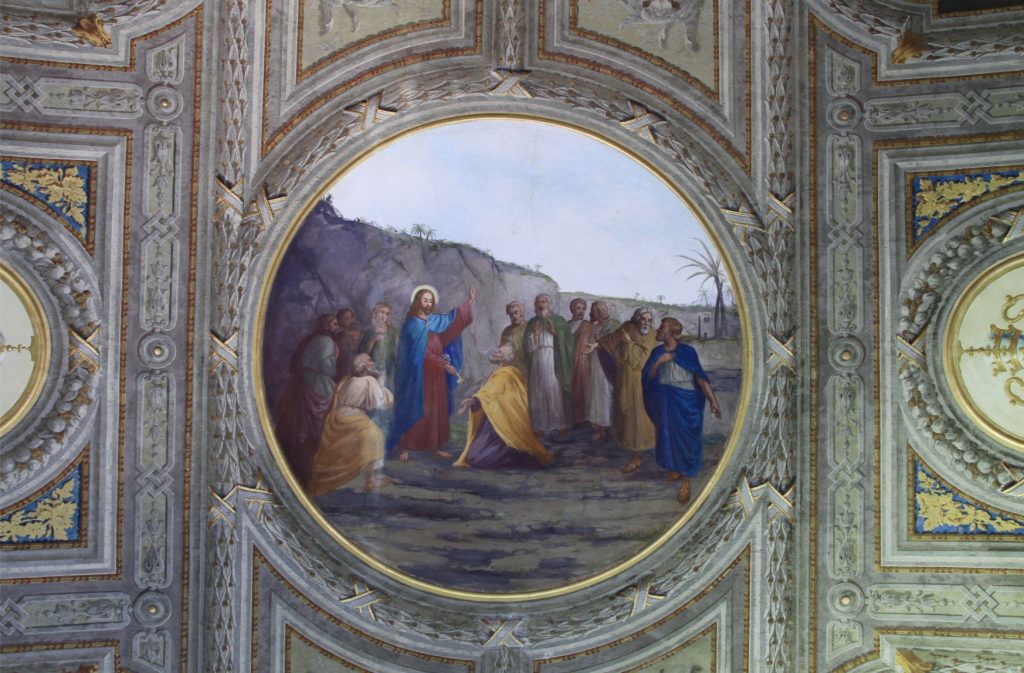
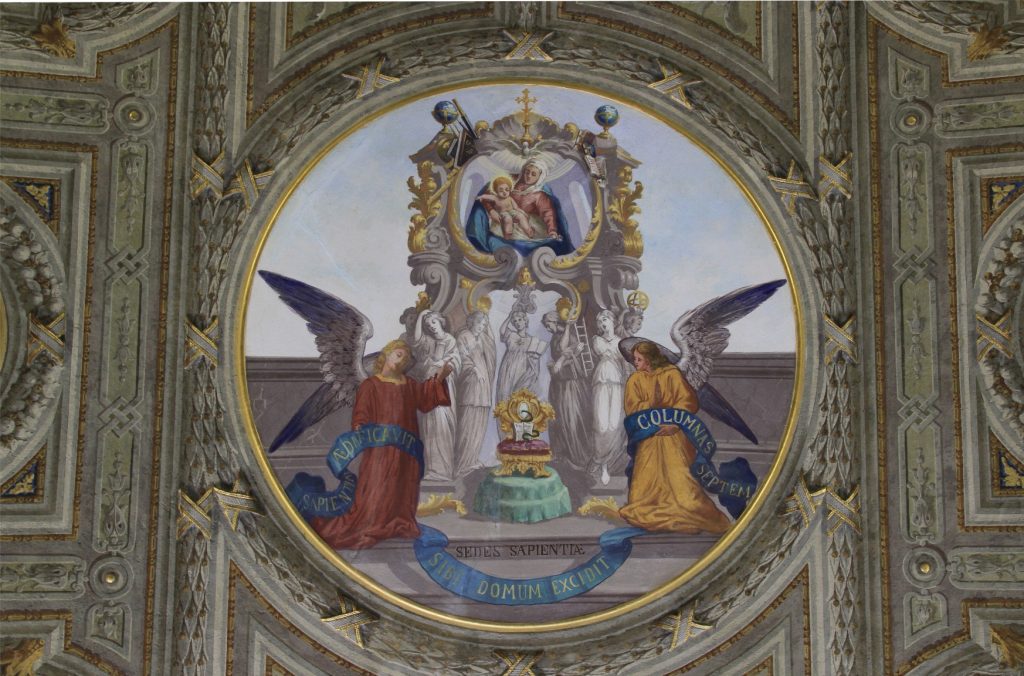
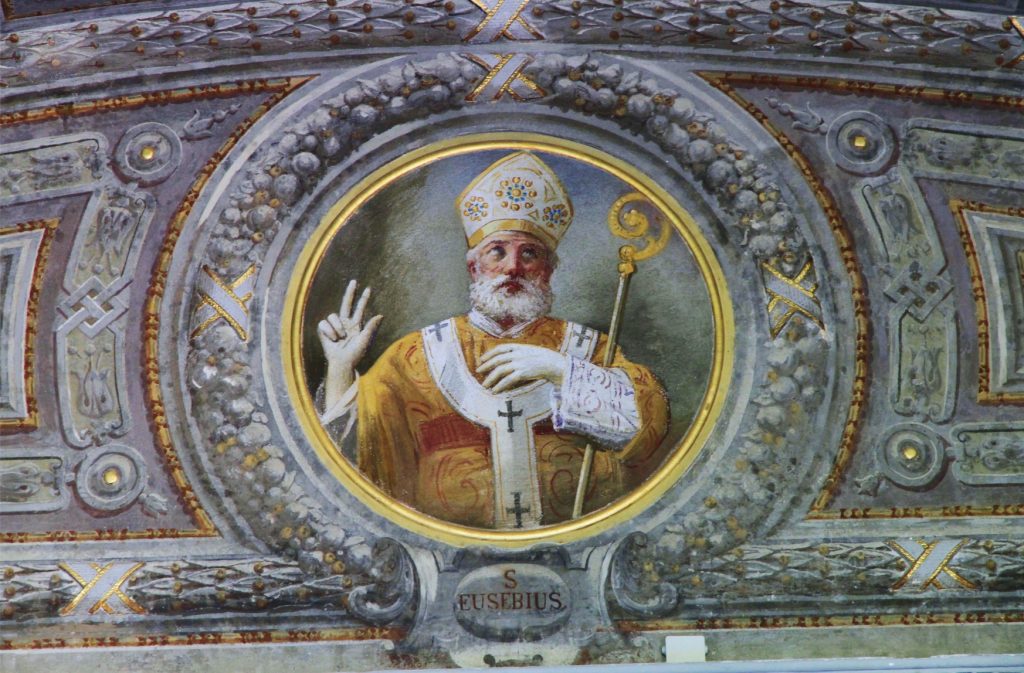
In the depiction of the handing over of the keys, the stylistic setting of the scene is reminiscent of the works of the Sardinian painter and decorator Baciccia Scano, who was active in Cagliari in the early 20th century. In the representation of the Virgin seated on an architectural throne among angels, the decorative apparatus recalls the style of the Tuscan decorator Citta, Baciccia Scano’s teacher, who worked for the municipality of Quartu in 1898. On the wall opposite the altar is a smaller frame depicting the Sardinian Saint Eusebius, bishop of Vercelli, represented in bishop’s robes in the act of blessing.
Among the numerous decorations in the chapel are several coats of arms of popes and bishops, as well as those referring to places in Cagliari and the Kingdom of Sardinia, such as that of Cagliari Cathedral depicting Saint Cecilia playing the organ and the coat of arms of the Quattro Mori. The pictorial decoration of the side lunettes also refers to typical images of the island: the Pisan tower, the nuraghe, a view of the sea, a church, an islet, and a shepherd in traditional dress.